October 2, 2026
Reviewed & Published by:
Jon Johns
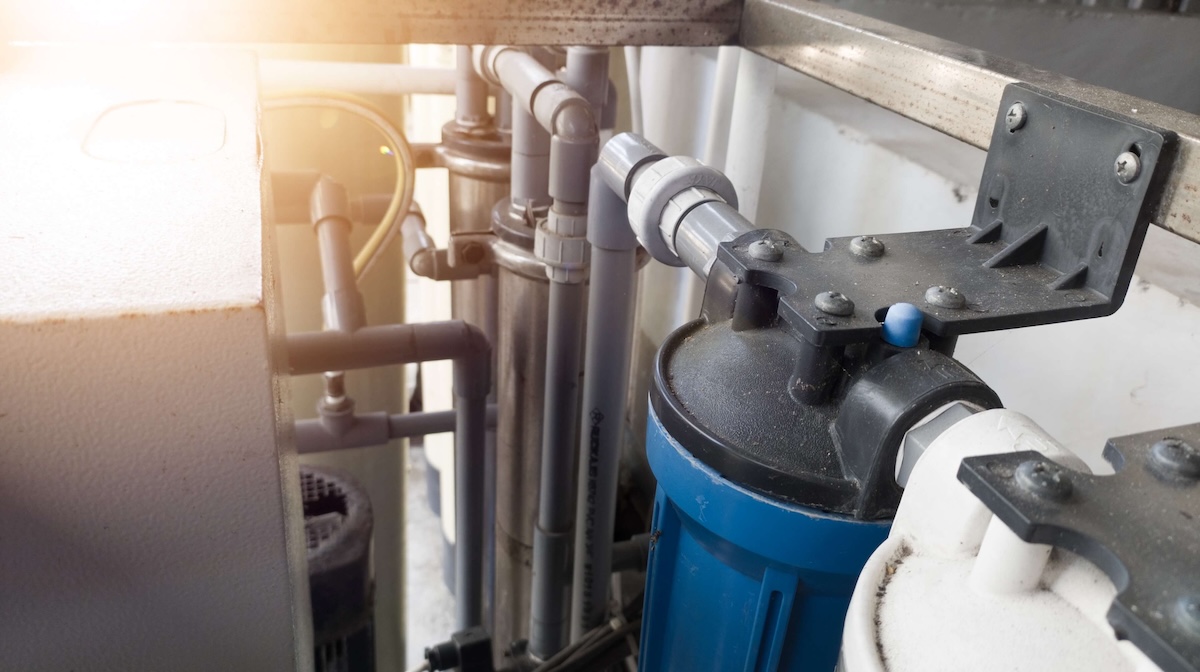
A water softener and a water filter get talked about like they're two versions of the same product. They aren't. They solve two different problems, and buying the wrong one is one of the more common (and more expensive) mistakes we run into on water quality calls.
Here's the short version. A water softener removes the minerals that make water hard, mostly calcium and magnesium. A water filter removes things you don't want in your water at all, like chlorine, sediment, iron, or whatever's causing a taste or a smell. Softeners treat hardness. Filters treat contaminants. They aren't interchangeable, and neither one does the other's job.
Which one your home needs comes down to a question most homeowners skip: what's actually in your water right now?
Hard water is water carrying dissolved calcium and magnesium. It picked those minerals up on its way through rock and soil, and there's nothing unsafe about drinking it. What it does is leave deposits behind on everything it touches.
That's the white crust on your showerhead. The spots on glassware that don't rinse off. Soap and shampoo that never quite lather, and skin that feels filmy after a shower. Over a longer stretch, it's scale building up inside your water heater and your fixtures.
A softener runs your incoming water through a tank of resin beads that swap the calcium and magnesium out for a small amount of sodium. That's the ion exchange you'll see referenced. Every few days the system flushes itself and recharges the resin using salt from a brine tank, which is why a softener needs salt refilled and a drain line to send the flush water somewhere.
What a softener does not do is clean your water. If your water tastes like chlorine, smells like sulfur, or is staining your sinks orange, a softener isn't going to change that. It wasn't built to.
Filtration is the broad category, and the right filter depends entirely on what you're trying to get out.
A whole-home carbon filter installed where water enters the house handles chlorine taste and odor, which is the most common complaint we hear from homeowners on municipal water. A sediment filter catches sand, grit, and rust particles, which matters more on well systems. Iron and manganese filters are their own category and use a different media entirely. Under-sink reverse osmosis handles drinking and cooking water at one tap, and it's the option people usually land on when they want something they can taste the difference in immediately.
The point is that "filter" isn't one product. Picking one without knowing what you're filtering is guesswork, and guesswork in this category gets expensive fast.
Before you price a single system, find out what you're treating. This is the step homeowners skip, and it's the reason so many people end up with equipment that doesn't fix what bothered them in the first place.
If you're on city water, your utility publishes an annual water quality report, sometimes called a Consumer Confidence Report. Concord, Kannapolis, and Salisbury-Rowan all put theirs online. It'll tell you what's in the water leaving the treatment plant, including hardness and what they use to disinfect. It's free, it's specific to your system, and it takes about ten minutes to read.
If you're on a private well, nobody is testing your water but you. North Carolina's public health department recommends testing at least once a year for bacteria and nitrates, and more often if the taste, color, or smell changes or if you've had flooding. You can run a full panel through your county health department or a state-certified lab, which will cover iron, manganese, pH, hardness, and metals. The NC Division of Public Health's well water testing guidance walks through exactly how to do it and what to ask for.
Once you have that in hand, the decision usually makes itself.
Here's something you won't hear from a company that sells softeners: most homeowners on municipal water in this part of the Piedmont don't need one.
Water in this region generally runs soft to moderately hard, which is a different picture entirely from the Midwest or the Southwest, where softeners are close to standard equipment. If your dishes aren't spotting and your showerhead isn't crusting over, hardness probably isn't your problem, and a softener will cost you money and salt to solve something you don't have.
What city-water homeowners around here actually call about is taste and smell, and that's almost always chlorine or chloramine from disinfection. A whole-home carbon filter handles it. So does a smaller under-sink system if you only care about drinking and cooking water. That's a filtration answer, not a softening one.
Pull your utility's report before you decide. If the hardness number surprises you, we'll take another look.
Well water is a completely different conversation, and it's where we do most of our water treatment work.
Wells in this area pull from groundwater that's been sitting in contact with rock, so mineral content runs higher and varies house to house. Two homes on the same road can test differently. The issues we see most are hardness, iron, manganese, low pH, and sulfur smell.
Hardness shows up the same way it does anywhere: scale, spotting, soap that won't lather. On a well it's often significantly higher than anything the city delivers.
Iron is the orange or reddish staining in toilets, tubs, and sinks, and the metallic taste that comes with it. The EPA's guideline is 0.3 milligrams per liter, and above that you'll usually see it before a lab confirms it. Manganese does the same thing in black instead of orange.
That rotten egg smell is hydrogen sulfide. It's unpleasant, it isn't fixed by a softener, and it needs its own treatment.
Low pH makes water slightly acidic, which is the quiet one. Acidic water eats at copper pipe and fittings from the inside and can leave blue-green staining around drains. It calls for a neutralizer, not a softener and not a carbon filter.
This is why a lot of well homes here end up with both a filter and a softener, in sequence, each handling what it's built for. It's also why a water test comes first. Guessing on well water means you either overbuy or you install something that doesn't touch the actual problem.
Well pressure and flow matter here too. Treatment equipment adds restriction, so if your system is already struggling, that gets sorted out before anything else goes in. That's part of why well pump service and water treatment tend to come up on the same visit. And if you're on a well near one of the two Duke coal ash sites in our area, we wrote a separate, plain-language piece on what coal ash means for well water in Rowan County and Lake Norman.
Want to learn more about your options? Give us a call to chat with a friendly guide.
.svg)
Yes, plenty of homes need both, and the order matters more than people expect.
The general rule is that filtration goes before the softener. Sediment, chlorine, and iron get pulled out first so they aren't loading up the softener's resin bed, which shortens its life and hurts performance. Both systems go upstream of your water heater, so the heater is getting treated water rather than raw.
On a well system, the treatment equipment goes after the pressure tank, never before it. A filter ahead of the tank restricts flow enough to keep the tank from filling properly, and then you've traded a water quality problem for a pressure problem.
There are exceptions. Very hard water with heavy iron sometimes calls for a different sequence, and flow rate has to be sized to the house so you aren't losing pressure when two showers run at once. That's the part that gets missed on DIY installs, and it's usually what we're called out to fix.
Worth knowing whichever direction you go: hard water is hard on water heaters.
In a tank, minerals settle to the bottom and insulate the burner, which means longer run times, more noise, and a shorter life. In a tankless unit, scale builds up inside the heat exchanger, and that's a much tighter space with less room for error. Either way, hard water shortens the life of the equipment if maintenance gets skipped.
If you're weighing a softener partly to protect a water heater, that's a legitimate reason, and it's worth reading through how hard water factors into the tankless decision before you commit either way.
A softener needs three things: space near where water enters the house, a drain for the regeneration cycle, and an outlet. In this area that's usually a garage, a crawlspace access wall, or a utility closet. The install itself is typically a few hours once the location is settled.
A whole-home filter is simpler. It's plumbed inline where water comes in, and depending on the type it either has cartridges you change on a schedule or a media bed that backwashes on its own.
Both need a bypass valve. That's non-negotiable in our book, because it means you can isolate the equipment for service without shutting water off to the whole house.
Salt-free conditioners come up often, so it's worth being straight about them: they don't remove hardness minerals. They change how those minerals behave so they're less likely to stick as scale. For some homes that's enough. If your goal is genuinely soft water, it isn't the same thing, and anyone telling you otherwise is selling.
On brands: when we install a softener or a whole-home filter, it's usually a CSI or Halo system.
A softener removes the calcium and magnesium that make water hard, using ion exchange and salt. A filter removes contaminants like chlorine, sediment, iron, or whatever's causing a taste or odor. A softener won't clean your water and a filter won't soften it. They solve different problems, and which one you need depends on what your water test shows.
Usually not. Municipal water in this part of North Carolina generally runs soft to moderately hard, so scale and spotting are less common here than in much of the country. Check your utility's annual water quality report for the hardness number first. If taste or odor is what's bothering you, that's a filtration issue, not a hardness one.
No. A softener handles hardness minerals only. Iron, manganese, sulfur smell, bacteria, and low pH each need their own treatment. Plenty of well homes in Rowan and Iredell County end up with a filter and a softener working together, but the water test has to come first so you're treating what's actually there.
Yes. Softening adds a small amount of sodium, roughly proportional to how hard the water was to begin with. Most people don't notice it. If you're on a sodium-restricted diet or you just prefer the taste of unsoftened water, the usual approach is to leave the kitchen cold tap unsoftened or add a small drinking water filter at that sink.
A quality softener that's sized correctly and maintained generally runs 10 to 15 years. What shortens that is running it on untreated well water with high iron or sediment, which fouls the resin bed. That's a big part of why filtration goes ahead of the softener on well systems.
Filtration first in most cases, so sediment, chlorine, and iron don't reach the softener's resin. Both go upstream of the water heater. On a well, everything goes after the pressure tank so you don't restrict the tank's ability to fill.
If you're not sure what's in your water, start with the test. Pull your utility's report if you're on city water, or run a panel through the county health department if you're on a well. Bring us what it says and Jonathan will give you a straight read on whether you need a softener, a whole-home filtration system, both, or nothing at all. We'd rather tell you that you don't need something than sell you equipment that doesn't fix your problem.
Call us at (704) 798-2659 or book online.

Jonathan Johns is the owner and lead plumber at Macaw Plumbing & Tankless, a family-owned plumbing company serving Salisbury, Mooresville, China Grove, and surrounding communities across Cabarrus, Rowan, and Iredell Counties. He holds NC State License #L.35944 (North Carolina P1 Unlimited Plumbers License) with Well Seal Certification and is a certified Navien Service Specialist.
.webp)
Licensed, family-owned plumbing experts providing honest, reliable service—from water heaters to emergency repairs—across China Grove, Salisbury, Mooresville, Lake Norman, and surrounding North Carolina communities.
Hours:
Monday – Friday (8am – 10pm)
Saturday (emergency plumbing)

.svg)

.svg)

.svg)
